Earlier today the Wall Street Journal showed how the myth of income stagnation and decreased social mobility is just that – a myth:
The Treasury study examined a huge sample of 96,700 income tax returns from 1996 and 2005 for Americans over the age of 25. The study tracks what happened to these tax filers over this 10-year period. One of the notable, and reassuring, findings is that nearly 58% of filers who were in the poorest income group in 1996 had moved into a higher income category by 2005. Nearly 25% jumped into the middle or upper-middle income groups, and 5.3% made it all the way to the highest quintile.
Of those in the second lowest income quintile, nearly 50% moved into the middle quintile or higher, and only 17% moved down. This is a stunning show of upward mobility, meaning that more than half of all lower-income Americans in 1996 had moved up the income scale in only 10 years.
Sounds to me like the American dream in its truest form – work hard, earn move, move up – is alive and well in this country.
More:
Also encouraging is the fact that the after-inflation median income of all tax filers increased by an impressive 24% over the same period. Two of every three workers had a real income gain–which contradicts the Huckabee-Edwards-Lou Dobbs spin about stagnant incomes. This is even more impressive when you consider that "median" income and wage numbers are often skewed downward because the U.S. has had a huge influx of young workers and immigrants in the last 20 years. They start their work years with low wages, dragging down the averages.
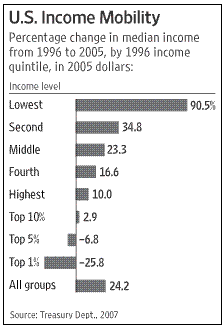
Those who start at the bottom but hold full-time jobs nonetheless enjoyed steady income gains. The Treasury study found that those tax filers who were in the poorest income quintile in 1996 saw a near doubling of their incomes (90.5%) over the subsequent decade. Those in the highest quintile, on the other hand, saw only modest income gains (10%). The nearby table tells the story, which is that the poorer an individual or household was in 1996 the greater the percentage income gain after 10 years.
In the face of these numbers I’m certain that there will be those who say that opportunity alone is not enough, that it’s not right for Americans to have to work hard to achieve success and move up the socio-economic ladder, that everyone is entitled to be in . To these people it’s important that outcomes be regulated so that the least productive are not overly "penalized" financially for their lack of contribution to the economy. It’s also important to economic egalitarians that the well-off be forced to pay for the needs of the poor and that their fiscal advantages be neutralized over time.
That seems to be happening too:
Only one income group experienced an absolute decline in real income–the richest 1% in 1996. Those households lost 25.8% of their income. Moreover, more than half (57.4%) of the richest 1% in 1996 had dropped to a lower income group by 2005. Some of these people might have been "rich" merely for one year, or perhaps for several, as they hit their peak earning years or had some capital gains windfall. Others may simply have not been able to keep up with new entrepreneurs and wealth creators.
The key point is that the study shows that income mobility in the U.S. works down as well as up–another sign that opportunity and merit continue to drive American success, not accidents of birth. The "rich" are not the same people over time.
This report shows that there is plenty of economic opportunity to go around in the U.S.A. While there is a vast gap between the poorest Americans and the richest there is also every chance for a poor American with a good work ethic and a good head on her shoulders to make an excellent life for himself in this country. Indeed, that may be more true today than ever before.
The WSJ’s conclusion, which I think speaks for itself:
The great irony is that, in the name of reducing inequality, some of our politicians want to raise taxes and other government obstacles to the kind of risk-taking and hard work that allow Americans to climb the income ladder so rapidly. As the Treasury data show, we shouldn’t worry about inequality. We should worry about the people who use inequality as a political club to promote policies that reduce opportunity.
h/t memeorandum